
The Next Oasis in Biotech
Finding & Capturing Value in Nature’s Untapped Innovations

There is a paradox at the center of building a biotech in 2026. It has never been easier to do groundbreaking science, but it has never been harder to capture value from doing it.
Two forces are driving this shift: the influx of AI and the ascendance of Chinese biotech. Models promise to revolutionize the speed and success rate of new programs, while China delivers real molecules with clinical data faster and cheaper than ever before. The playbook that worked for the past two decades is no longer valid; we’re playing a fundamentally new game and the rules are still being written. The question of what’s worth building has never been more challenging to answer.
At Moab, we believe defensible value capture comes from realizing the following:
Incremental is not enough. The greatest value will be found in the spaces where people aren’t building yet.
Target systemic gaps in models and technology. Find defensibility in the problems existing tools can’t solve.
Biology is still a frontier. Nature’s best technologies still haven’t been industrialized.
Incremental is not enough
Crowded modalities are crowded because their value is easily defined, the science is tractable, and the technology is mostly de-risked. It’s possible to fight it out and stake a claim, but the largest opportunities are in the spaces that the market has not even priced because the technology does not exist yet. Category-defining companies are not created by arriving as the tenth entrant in someone else’s category. What are the odds of creating a blockbuster with the 10th RAS-targeted molecular glue, 20th VEGF x PD-(L)1 bi-specific, or 80th B-cell-depleting T-cell engager? Some will get a slice of a big pie, but wouldn’t it be preferable to bake a cake that you can have to yourself? That’s what we’re building at Moab.
We focus on a categorically new modality that no one else is working on, for biologically validated targets that are not tractable with today’s drugs. We call them Torins, a new type of miniprotein therapeutic. We imagine a world where binders move beyond antibodies, unlocking a step change in what a drug can look like. What if a binder could be 30x smaller than an antibody? Shelf-stable? Orally bioavailable? Able to hit epitopes antibodies can’t reach? Easily logic-gated? Manufactured at 10X lower COGS? Torins answer every one of those questions, creating and capturing value that incremental changes to antibodies, peptides, and small molecules can’t.
Target systemic gaps in models and technology
There’s no denying that frontier models and China’s rapid development infrastructure are reshaping drug discovery. Nevertheless, they both have huge gaps that cannot be easily closed with more compute or NHP studies. If you want to build something that won’t be swallowed up by the next generation of models or Chinese CROs, it’s imperative to build outside of their training distribution and conventional discovery services.
Many will argue that protein structure prediction and binder generation are solved problems. For some targets and applications, that’s true, but we’d also argue that in many ways, it is not. We’ve pressure tested every publicly available frontier model and none of them can predict empirical Torin structures accurately (Figure 1). The leading minibinder generation models almost exclusively produce helical bundles that have rarely succeeded as a drug and can be easily copied and iterated upon. Torins break all the rules that every leading model has learned, yet nature has produced untold numbers of them against countless targets.
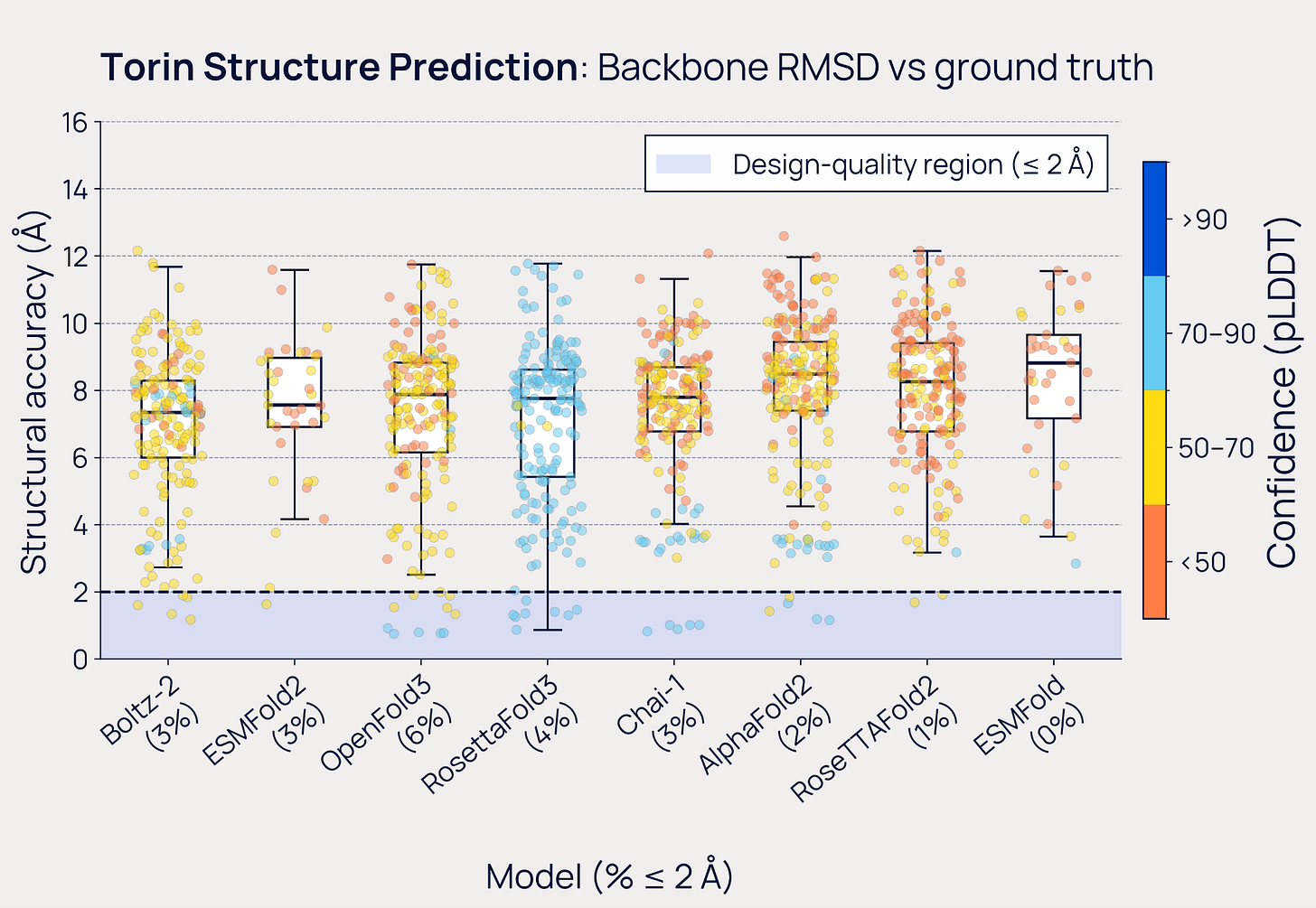
Figure 1. Structure prediction of Torins. A benchmark set of naturally occurring Torins with experimentally determined structures was evaluated using structure prediction models. Multiple sequence alignment (MSA) input was provided where applicable. Predictions with backbone RMSD ≤ 2 Å are shown in the highlighted region corresponding to design-quality accuracy.
Biology is still a frontier
Almost every biologic ever produced falls under just a handful of forms: antibodies, enzyme replacements, cell and gene therapies. All derived from nature’s own answers to biological problems. Yet that’s just a tiny fraction of nature’s full proteome, which has solved (almost) every problem life has encountered since it began. It’s easy to believe in 2026 that we have a complete picture of biology, but that is far from the truth.
Torins are built upon a natural scaffold, sitting right under our noses, yet barely studied. These molecules evolved through multi-parameter optimization over millions of years in mammals to have ideal drug-like properties. So, why haven’t they been industrialized? For a multitude of reasons: they hadn’t been discovered, there was little market pressure to innovate outside of the known modalities, and the technology did not exist to program the natural scaffold into an engineered biologic. We believe Torins are one of the best answers to “What’s worth building in 2026?” and there has never been a better time to do it.
A new oasis
Nature already recognized the need to develop binding modalities that extend the functional targeting space beyond conventional antibodies & small molecules - and it generated Torins. We are not designing a new modality from scratch, but industrializing molecules that nature has already validated. In our first year, we built the only stack in the world designed to industrialize this scaffold: a specialized protein language model trained on data no one else has, a discovery engine screening trillions of designs a day, and the developability and manufacturing infrastructure to take Torins to the clinic.
As a therapeutic, Torins are positioned to be a category creator. They are capable of accessing ‘undruggable’ targets and overcoming the design and delivery limitations of conventional modalities, each of which are necessary to create effective treatments for complex disease. They achieve this through a unique combination of features:
Size: Torins are 5 kDa, allowing them to access hidden epitopes, achieve deeper tissue penetration, have tunable PK/PD profiles, and be easily manufactured, including through solid-phase synthesis.
Stability: Engineered with multiple disulfides, Torins are ultrastable on both the shelf and in the gut, making them less reliant on cold-chain and potentially bioavailable in oral formulations.
Modularity: Torins’ unique architecture allows them to be easily fused with other molecules to rapidly create multi-specifics, logic-gated binders, and ADCs, and opens the possibility of easy re-purposing.
We built Moab to address our three theses about how to generate and capture value in 2026. Torins truly exist in the white space, as we are the only company pursuing them commercially. No frontier model can fold or generate them and no Chinese CRO offers discovery services for them. They are just one example of nature’s innovations that have yet to be thoroughly studied, let alone developed as therapeutics. Biotech was born when Genentech pioneered the industrialization of recombinant proteins. Novo Nordisk and Lilly are defining the most recent era of peptide therapeutics with GLP-1s, a drug class whose discovery traces back to a peptide in Gila monster venom. As AI and China continue to eat biotech, the next era will be defined by companies that leverage both to build in the places that neither can alone. Moab is that company and Torins are where we begin. Nature has been doing discovery for billions of years while industry has just scratched the surface. We’re thrilled to be changing that at Moab and look forward to sharing more updates on our progress soon.
One thing I keep turning to is the moat, which reads as "models can't fold Torins," but your own PLM seems to prove the scaffold is learnable, just under-trained for now. Which means the durable edge is the proprietary data and the head start, not the biology being AI-proof. Stronger position, really, is that data leads compound; "the tech can't do this" expires. Curious how you defend the data lead once others notice the scaffold.